You’re forty minutes into a four-hour layover at O’Hare. Your iPhone 15 Pro Max is at 11%, your Samsung Galaxy S24 Ultra is negotiating a roaming handshake with a T-Mobile international partner, and the nearest wall outlet has a line. This is the moment every wireless traveler eventually faces — and the only thing standing between you and a dead device is the portable charger (also called a power bank, an external battery pack that stores electrical charge and delivers it to your devices via cable or wireless pad) sitting in your carry-on. But not all power banks are created equal. Capacity, charging speed, cable compatibility, and — critically — what the TSA will and won’t let you bring aboard all determine whether that brick in your bag actually saves you. This guide breaks down exactly what to look for, names the tradeoffs honestly, and gives you a clear decision rule at the end.
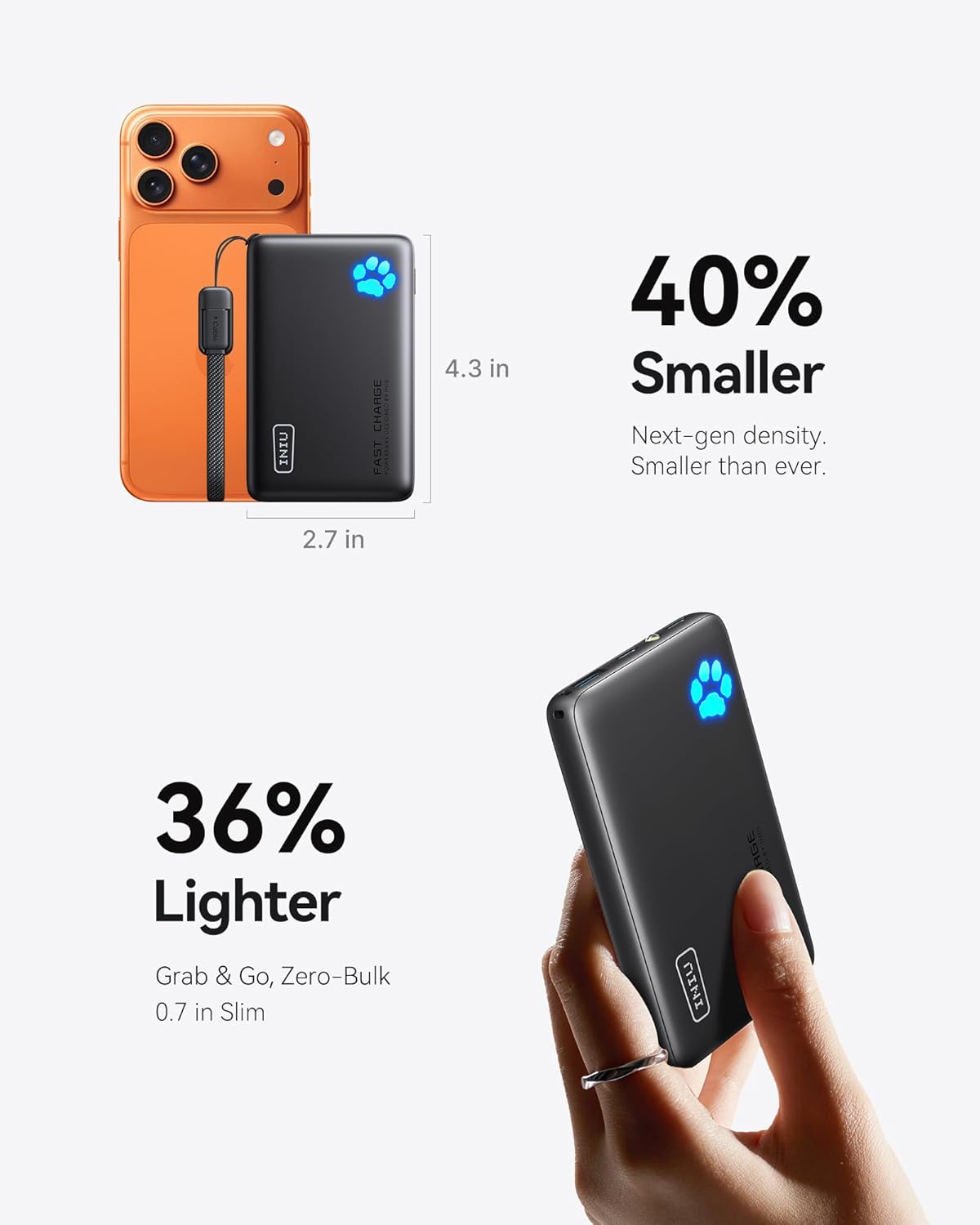
| EDITOR'S PICK[Anker Laptop Power Bank](https://www.amazon.com/dp/B0DMDJBCDP?tag=greenflower20-20) | Mid-tier[Anker Power Bank](https://www.amazon.com/dp/B0CXDXP8VR?tag=greenflower20-20) | Budget pick[INIU 45W Fast Charging Portable…](https://www.amazon.com/dp/B0CB1FW5FC?tag=greenflower20-20) | |
|---|---|---|---|
| Capacity | 25,000mAh | 20,000mAh | 10,000mAh |
| Max Total Power | 165W | 87W | 45W |
| USB-C Ports | 3 | — | — |
| Built-in Cables | Retractable | USB-C | Detachable |
| Price | $119.99 | $69.99 | $19.98 |
| See on Amazon → | See on Amazon → | See on Amazon → |
The Numbers You Actually Need to Understand
Before any product recommendation makes sense, three specs need to be in your vocabulary.
Capacity (mAh): Milliamp-hours measure how much total charge a bank holds. A higher number means more charges before the bank itself needs to be plugged in. The iPhone 15 Pro Max carries a roughly 4,400 mAh internal battery; a 20,000 mAh power bank is theoretically about four full charges — in practice, closer to three, because of conversion losses during transfer.
Wattage (W) and Power Delivery (PD): Watts determine how fast charge moves. Standard USB-A ports push 5–12W, which is fine for overnight top-ups but painfully slow mid-travel. USB-C ports supporting Power Delivery (PD) — a fast-charging standard that negotiates higher voltages between the charger and device — can hit 20W, 45W, 65W, or beyond. The Galaxy S24 Ultra supports 45W wired charging; an iPhone 15 Pro Max tops out at 27W from a power bank. If your bank can only push 18W over USB-C PD, you’re leaving speed on the table.
GaN: Gallium Nitride, a semiconductor material that replaced older silicon in premium charger circuitry. GaN chargers and power banks run cooler and pack more wattage into a smaller footprint — relevant when ounces matter.
By the Numbers: Flagship Device Battery Sizes vs. Common Bank Capacities
| Device | Internal Battery | Charges from 10,000 mAh Bank* | Charges from 20,000 mAh Bank* |
|---|---|---|---|
| iPhone 15 Pro Max | ~4,400 mAh | ~1.7× | ~3.4× |
| Samsung Galaxy S24 Ultra | ~5,000 mAh | ~1.5× | ~3.0× |
| Google Pixel 9 Pro | ~4,700 mAh | ~1.6× | ~3.1× |
*Real-world figures after ~20% conversion loss, per published efficiency data cited in Wirecutter’s portable charger testing methodology.
TSA Rules: The Constraint That Overrides Everything Else
Here’s the piece most buying guides bury: the TSA and IATA (International Air Transport Association, the body that sets global airline safety standards) restrict power banks by watt-hours (Wh), not mAh. Checked bags? Lithium-ion power banks are generally prohibited entirely — they must ride in your carry-on where a fire can be managed. Carry-on limits are:
- Under 100Wh: Permitted, no airline approval needed.
- 100–160Wh: Permitted in carry-on, but some airlines require approval in advance. Delta, United, and most international carriers allow these; check before you fly.
- Over 160Wh: Prohibited on passenger aircraft, full stop.
Converting mAh to Wh: multiply mAh × voltage ÷ 1,000. Most power banks run at 3.7V internally. So a 20,000 mAh bank = 20,000 × 3.7 ÷ 1,000 = 74Wh — comfortably under 100Wh. A 26,800 mAh bank at 3.7V comes to roughly 99.2Wh, still under the limit, but you want to see the Wh rating printed on the device itself — TSA agents check labels, per the TSA’s published guidance on lithium batteries in carry-on baggage.
Practical rule for the wireless traveler: Anything at or under 20,000 mAh (verify the printed Wh is under 100Wh) is the safest travel tier. You can push to 26,800 mAh and stay under 100Wh with most banks in that class, but confirm the label before you pack.
Matching Bank Tier to Your Actual Travel Profile
The intermediate traveler’s mistake isn’t buying a bad power bank — it’s buying one optimized for the wrong use case. Here’s how to frame the decision.
Light Carry: One Day, One Device
If you’re flying for a day trip, carrying one flagship phone, and can charge at your destination, a 10,000 mAh bank with 20–30W USB-C PD is the sweet spot. It’ll fit in a front pocket, weigh under 200g, and deliver roughly 1.5–2 full charges to any current flagship. Wirecutter’s portable charger guide consistently returns to the Anker 511 Power Bank tier for this profile — compact, genuinely 20W over USB-C, and priced under $30 at most retailers. Owners across aggregated reviews note that the 511 doesn’t sacrifice charging speed for its size, which is the main pitfall of ultracompact banks.
Road Warrior: Multi-Day, Multi-Device
If you’re traveling 3–5 days between reliable charging access, carrying a flagship phone plus a tablet or laptop, the calculation shifts to a 20,000–26,800 mAh bank with at least 45W USB-C PD output, ideally with two USB-C ports running simultaneous PD. The Anker 737 PowerCore (26,800 mAh, 140W output) targets exactly this profile. PCMag’s review of the Anker 737 highlights its ability to fast-charge a MacBook while simultaneously topping a smartphone — a genuinely useful dual-output scenario for the remote worker who’s also trying to keep a hotspot alive. It’s larger and heavier (~620g), but the tradeoff is explicit: you’re choosing capacity and speed over portability.
Wired’s portable charger guide flags a similar option in the Baseus Blade family for travelers who want laptop-level wattage (65W) in a slimmer form factor — reviewers note it fits more naturally into laptop sleeves than the Anker cylinder form.
The Wireless Charging Question
Several premium banks now include a Qi2 (the second-generation wireless charging standard, which locks magnetic alignment and delivers up to 15W without a cable) pad on the back or top surface. For iPhone 15 and 16 series users who’ve built their routine around MagSafe, this is genuinely useful. For everyone else — including Galaxy S24 Ultra owners — wireless charging from a power bank is slower, hotter, and wastes more energy than a cable. Tom’s Guide’s power bank roundup explicitly notes that wireless passthrough charging on banks typically delivers 7.5–10W effective throughput, versus 25–45W over a USB-C PD cable on the same device. Unless your specific workflow requires wireless, cable is faster, more efficient, and adds no friction.
The MVNO and Multi-SIM Traveler’s Specific Case
If you’re traveling internationally with an eSIM (an embedded SIM, a programmable digital SIM card built into your device that lets you activate a carrier plan without swapping a physical chip) activated for a local data plan alongside your domestic line, your phone is managing two active radios. Owners of dual-SIM flagship setups on international trips consistently report meaningfully higher battery drain — 15–25% more per hour of active use under dual-radio load, per aggregated owner data cited in GSMArena’s long-term usage notes for multi-SIM flagship devices. That’s not hypothetical: it’s the difference between a 10,000 mAh bank getting you through a day versus falling short by evening. The multi-SIM international traveler should default to 20,000 mAh minimum.
Features Worth Paying For vs. Features That Are Marketing
Worth it:
- USB-C PD at 30W or higher: The single biggest real-world speed improvement over budget banks. If the port says USB-C but the spec sheet shows 18W, it’s USB-C cosmetically, not functionally.
- Pass-through charging: The ability to charge the bank and a device simultaneously from one wall connection. Useful for hotel rooms with single outlets.
- LED or digital battery indicator: Analog LEDs (four dots) are guesswork. Banks in the $50+ range increasingly ship with a small percentage display. Worth it for planning.
- Airline-printable Wh label: Sounds trivial, but travelers who’ve had banks confiscated at international airports know: if the Wh isn’t printed on the bank, some agents default to confiscation.
Marketing noise:
- “Solar charging” side panels on sub-$100 banks: The surface area on a portable bank is far too small to deliver meaningful charge in any practical timeframe. Across aggregated reviews on Tom’s Guide and Wirecutter, solar panels on compact banks add ~1W of trickle input under direct sunlight — irrelevant for the use case.
- Wireless charging output on a power bank (unless you’re specifically an iPhone MagSafe user, per the Qi2 note above).
- “Military-grade” ruggedization claims without an IP rating (IP = Ingress Protection, a standardized scale for dust and water resistance): meaningful protection is quantified; marketing language without a number is not.
The Decision Rule
If you’re building your carry for wireless travel and your decision is currently pending, here’s the framework:
- One device, day trips, portability priority → 10,000 mAh, 20–30W USB-C PD, under 200g. Anker 511 tier. Under 100Wh. No airline friction.
- One flagship + tablet/laptop, multi-day trips → 20,000–26,800 mAh, 45W+ USB-C PD with dual output. Anker 737 or Baseus Blade tier. Verify Wh label is printed and under 100Wh before flying internationally.
- Dual-SIM eSIM international traveler → Default to 20,000 mAh minimum regardless of trip length. Dual-radio drain will consume your buffer faster than your domestic use history suggests.
- MagSafe / Qi2 iPhone workflow → Add the wireless output premium if and only if you’ve already built your daily routine around MagSafe; otherwise the cable is faster and the feature is friction.
The one thing the spec sheet won’t tell you: the best power bank is the one you actually put in the bag. At 11% battery, the Anker 511 in your carry-on beats the Anker 737 charging in your hotel room. Buy the capacity tier you’ll carry, not the tier you wish you needed.