You’re in a familiar spot: a client — or maybe yourself — is staring down a $1,200 Samsung Galaxy S25 Ultra or a $1,099 iPhone 16 Pro Max and wondering whether the price is actually justified, or whether it’s just brand gravity doing its thing. “Flagship” means a phone at the top of a manufacturer’s lineup, loaded with the fastest processor available and the most capable cameras. But “flagship pricing” doesn’t have to mean Apple or Samsung. Two brands — Nothing and OnePlus — are shipping phones in 2025–2026 that carry the same class of processor, comparable camera hardware, and legitimate 5G (fifth-generation wireless, the fastest widely available network standard) credentials, at prices that open up meaningful room in a purchasing decision. This guide compares the Nothing Phone 3 and OnePlus 15 side by side, shows you the real cost math, and ends with a clear decision framework so you can stop sitting on the fence.
What You’re Actually Comparing (And What You’re Giving Up)
Let’s anchor the spec context first, because “flagship alternative” is a phrase that gets applied to a lot of mediocre phones.
Both the Nothing Phone 3 and OnePlus 15 ship with Qualcomm’s Snapdragon 8 Elite — the same silicon found inside the Galaxy S25 Ultra and the OnePlus device’s direct competitors in early 2026. Per GSMArena’s Nothing Phone 3 full specifications page, the phone pairs that chip with 12GB of RAM (random-access memory — the working memory that keeps apps running smoothly) in its base configuration and up to 16GB in higher storage tiers. OnePlus goes further: Tom’s Guide’s full OnePlus 15 review confirms 12GB/16GB configurations as well, with an aggressive starting price that undercuts even Nothing’s positioning.
Neither phone is a compromise on raw performance. Where the tradeoffs live is in software longevity, carrier compatibility, and ecosystem depth — and those are exactly the factors that matter when you’re counseling a buyer, evaluating a trade-in cycle, or deciding what to carry personally on an international trip.
By the numbers — mid-May 2026 street pricing:
| Device | Launch Price (USD) | OS Update Commitment | 5G Bands (Sub-6 / mmWave) |
|---|---|---|---|
| Nothing Phone 3 | $699 | 3 years OS, 4 years security | Sub-6 only (US variant) |
| OnePlus 15 | $899 | 4 years OS, 5 years security | Sub-6 + limited mmWave |
| Samsung Galaxy S25 | $799 | 7 years OS + security | Sub-6 + mmWave |
| iPhone 16 | $799 | 5–6 years (historical) | Sub-6 + mmWave |
mmWave (millimeter wave) is the ultra-fast but short-range flavor of 5G found in dense urban environments — stadiums, airports, downtown corridors. Sub-6 GHz 5G covers more ground and is what most users actually connect to most of the time.
Nothing Phone 3: The Design-Forward Disruptor
Nothing’s brand identity is built around its Glyph Interface — a system of programmable LED strips on the phone’s transparent back panel that light up for notifications, charging indicators, and even as a makeshift fill light for video calls. It’s not a gimmick for most buyers who engage with it; Android Authority’s Nothing Phone 3 review notes that owners in extended use consistently report finding Glyph notifications genuinely useful for silently triaging calls in meetings, something a vibration pattern can’t replicate with the same precision.
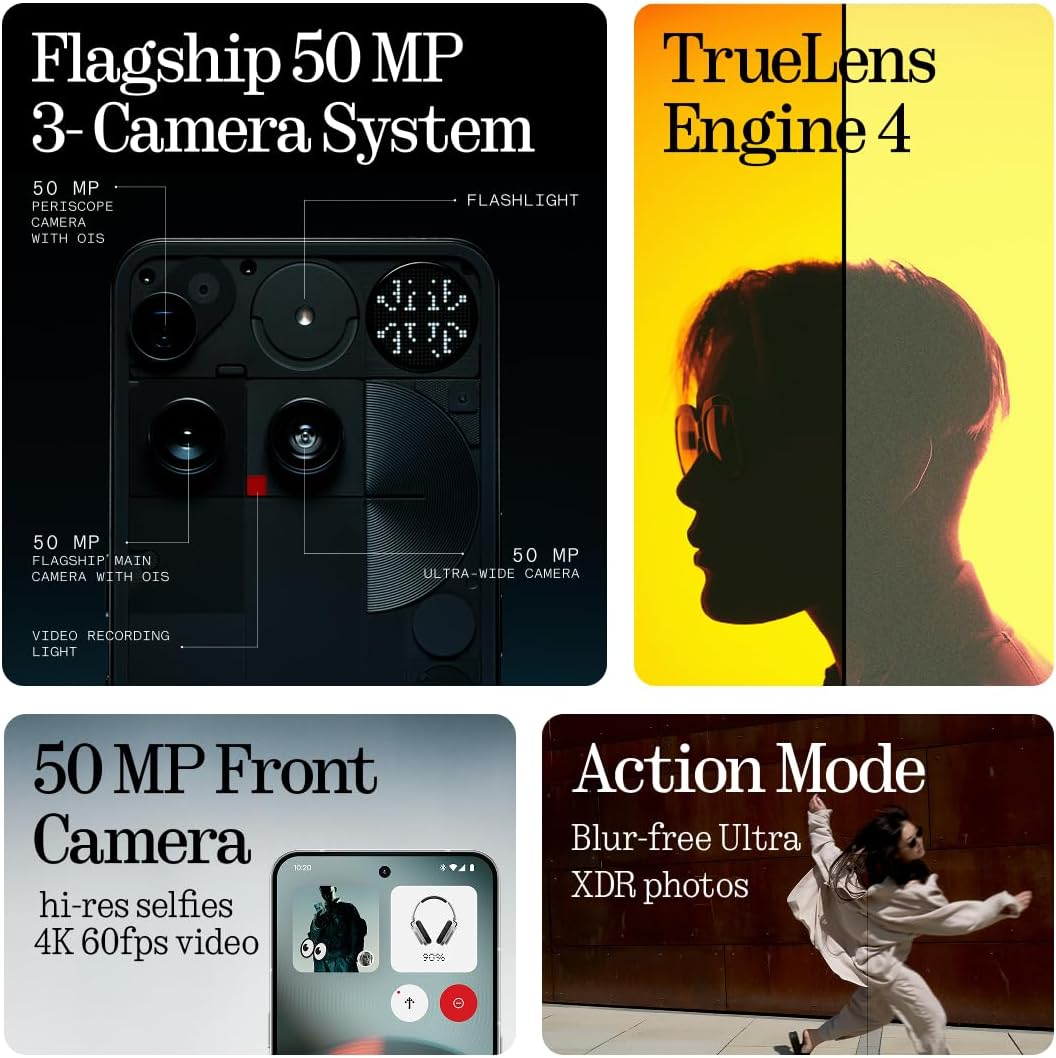
The camera system on the Phone 3 is where Nothing made the most meaningful jump from its predecessors. The primary sensor is a 50-megapixel main shooter with optical image stabilization (OIS — a physical mechanism that compensates for hand movement, producing sharper photos and smoother video). The ultrawide and telephoto configuration is competitive for the price tier, though Android Authority’s reviewers note that in low-light telephoto situations, the processing pipeline trails what Samsung and Google deliver with their more mature computational photography stacks.
Who this phone is for, specifically:
- Buyers who want to be visually distinct from the iPhone/Samsung mainstream — Nothing’s aesthetic is genuinely polarizing, which means it has real identity value for users who care about that
- International travelers: the unlocked variant supports a wide range of GSM (Global System for Mobile — the radio standard used across most of Europe, Asia, and Latin America) and LTE bands, making it more travel-friendly than some carrier-locked alternatives
- eSIM (embedded SIM — a digital SIM card built into the phone that lets you switch carriers without a physical card) support is confirmed for the US variant, which matters if you’re evaluating it alongside an MVNO (mobile virtual network operator — a carrier like Mint Mobile or Visible that leases network access from a major carrier instead of owning towers)
The honest tradeoff: Nothing’s US carrier support is narrower than OnePlus’s. The Phone 3 lacks mmWave support in its North American variant, which means it won’t hit theoretical gigabit speeds in mmWave-covered urban zones. For 90% of real-world use cases this is irrelevant, but if your buyer is in a dense downtown market and uses their carrier’s premium tier specifically for the speed benefit, note it.
OnePlus 15: The Value Flagship With a Serious Camera Alliance
OnePlus has been playing a longer game in the US market and it shows in the OnePlus 15’s spec sheet. The Verge’s OnePlus 15 review describes the device as “the most complete OnePlus phone shipped to the US market,” specifically calling out the Hasselblad camera tuning partnership — a collaboration with the Swedish camera company that shapes color science, white balance calibration, and the phone’s professional shooting modes.
Hasselblad’s involvement is about color rendering philosophy, not just marketing. Reviewers at The Verge and Tom’s Guide consistently note that OnePlus 15 photos have a more neutral, film-adjacent color rendition compared to Samsung’s often-saturated processing. Whether that’s better depends entirely on your buyer’s preference, but it’s a real and noticeable difference.
Software longevity is the sleeper argument for OnePlus 15. A four-year OS update commitment plus five years of security patches is a meaningful spec in a purchasing conversation. Spread a $899 purchase over four guaranteed major Android updates and you’re at roughly $225 per year of fully supported ownership before you factor in resale value. PCMag’s Best Flagship Alternatives 2026 roundup flags this update window as one of the primary reasons the OnePlus 15 earns consideration against the Galaxy S25 at a similar price point.
Charging speed is the other headline differentiator. The OnePlus 15 supports 100W wired fast charging (manufacturer-rated), which Tom’s Guide’s review confirms translates to a full charge in approximately 30 minutes in real-world owner reports. Wireless charging tops out at 50W with OnePlus’s proprietary charger. Nothing Phone 3 trails here with 45W wired charging — still fast by any reasonable standard, but a genuine gap if charging speed is a priority criterion.
Who this phone is for, specifically:
- Small-business owners and remote-work buyers who run a single device hard and need the software runway — four OS updates means a 2026 purchase is supported well into 2030
- Buyers coming from a Samsung Galaxy mid-range device (A54, A35) who want a flagship processor without paying flagship Samsung prices
- Anyone who has been burned by short software support windows on past Android purchases and wants commitment in writing (OxygenOS, OnePlus’s Android skin, publishes its update policy explicitly)
The Trade-In Math You Need to Run Before Recommending Either
Here’s where the “flagship alternative” category has historically stumbled: resale and trade-in value. The honest version of this conversation matters.
Samsung and Apple devices hold value better in the carrier trade-in programs. If your buyer is evaluating a Nothing Phone 3 or OnePlus 15 as a device they’ll trade in at a T-Mobile or Verizon store in 24 months, the math likely doesn’t favor the alternative brands. Carrier trade-in programs are structured around Samsung and Apple inventory because those are the devices the carriers can resell or recycle at scale.
Where the alternative brands recapture ground is in the unlocked, direct-sell resale market — platforms like Swappa or eBay (third-party market, not carrier-dependent). OnePlus 15 holds residual value reasonably well in that channel, per aggregated pricing data visible on GSMArena’s market tracking pages, precisely because the Snapdragon 8 Elite stays competitive longer than mid-range chips.
The decision rule here is simple: if your buyer is locked into a carrier upgrade cycle and depends on trade-in credits, steer them toward a Galaxy S25 or iPhone 16. If they’re buying unlocked with cash or financing directly and intend to sell privately at upgrade time, the Nothing Phone 3 and OnePlus 15 both represent better value-per-dollar on the front end, with acceptable (though not class-leading) resale floors.
The Decision Framework: If X, Then Y
After working through the specs, pricing, and tradeoffs, here’s the clearest way to route a decision:
If the buyer prioritizes design identity and international travel flexibility → Nothing Phone 3 at $699. The Glyph interface is unique, the unlocked variant handles global GSM bands well, eSIM support enables easy MVNO pairing for international SIMs, and the price leaves $100–$200 for a quality case or a premium wireless plan upgrade.
If the buyer prioritizes software longevity, camera quality, and charging speed → OnePlus 15 at $899. The Hasselblad partnership produces a camera system that reviewers consistently rank above Nothing’s offering in color accuracy and low-light telephoto. The five-year security patch window is the longest commitment in the Android flagship-alternative segment as of mid-2026. The 100W charging is a legitimate daily-use advantage.
If the buyer is in a carrier trade-in upgrade cycle → Neither. Route them to a Galaxy S25 or iPhone 16 where carrier promotions and trade-in programs are built to deliver value on paper. The alternative flagships are unlocked-market plays.
If the buyer is an MVNO evaluator combining a device purchase with a plan switch — say, moving from a postpaid carrier to Visible or Mint Mobile — both the Nothing Phone 3 and OnePlus 15 are strong pairings. Both are unlocked, both support eSIM, and neither requires a carrier agreement. That combination of a $699–$899 device cost with a $25–$45/month MVNO plan is one of the genuinely underappreciated value propositions in the current market.
The $1,000+ flagship tier earns its price in specific ways: longer software support from Apple, deeper carrier integration, and trade-in program leverage. But for buyers who know they’ll hold a device for three-plus years, buy unlocked, and prioritize daily performance over brand ecosystem? Nothing Phone 3 and OnePlus 15 are no longer compromise choices. They’re informed ones.